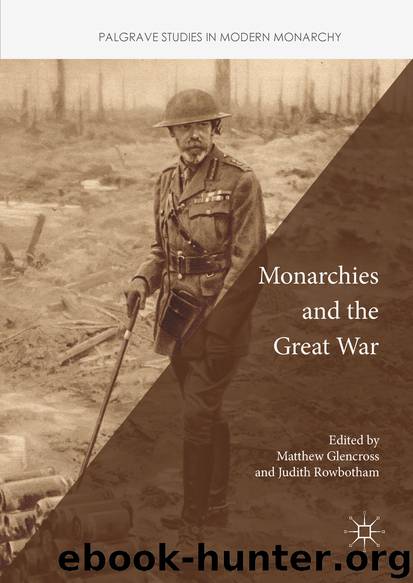
Monarchies and the Great War by Matthew Glencross & Judith Rowbotham
Author:Matthew Glencross & Judith Rowbotham
Language: eng
Format: epub
ISBN: 9783319895154
Publisher: Springer International Publishing
George’s Military Background
It is unsurprising that George V would look to a relationship with his soldiers and sailors as a core element of kingship at a time of national conflict. Back in 1901, towards the end of the Boer War, he and his wife (they were then the Duke and Duchess of Cornwall and York) had embarked on a much-photographed and well-received royal tour of the colonies which had contributed so much to the conflict. A regular feature of the tour had been the presenting of medals to veterans (including nurses from the colonies who had served in what was about to become Queen Alexandra’s Imperial Military Nursing Service).12 In 1914, he looked to build on this prior experience, especially in terms of active involvement with veterans. His habit of viewing his commitments through the lens of duty in general ensured that ‘his’ men (and women)—those fighting in his name—ensured he was very conscious of symbolism of that aspect. The words ‘God, King and Country’ was a weighty consideration for him in a way that directly related to his experience of serving as an ordinary career naval officer.13
During his fifteen years of service, his engagement with the Navy had been that of an active career officer. He had served on various ships in various parts of the Empire, being treated on the vast majority of occasions merely as an ordinary officer, with no notice being taken of his royal connections. This is something underlined by his promotion to command of his own ship, HMS Thrush, on the North American station in 1889. The experience of serving as an officer in the Queen’s name, something completely detached from his family relationship with his grandmother the Queen, lay at the heart of George’s conviction that, now he was the monarch, he had an obligation to be actively involved in the war effort in ways that went beyond the ceremonial. This had, of course, included expectations of a regular engagement between the monarch and the armed services, which involved the reviewing of review troops before departure and on return, from active service and the presentation of medals.
The development of the philanthropic face of monarchy under Victoria in particular had established an expectation also of royal women visiting military wounded when back in Britain, and from the Boer War on, George had also adopted this habit, often going with his wife and later, his daughter.14 Unlike his recent predecessors, however, his personal experience of what it was like to serve in the name of the monarch meant that he knew from personal experience the gratification that usually resulted from such visits and other royal engagement delivered by the King, in terms of the boost given to morale and effectiveness given by direct encounters with royal interest.
The insights of this nature that arose out of his military experience were not his only asset as a wartime king. Unlike his father, Edward VII, George was ill at ease in the company of politicians, scholars and economists, where his lack of university education and conversational flair could be daunting to him.
Download
This site does not store any files on its server. We only index and link to content provided by other sites. Please contact the content providers to delete copyright contents if any and email us, we'll remove relevant links or contents immediately.
| Africa | Americas |
| Arctic & Antarctica | Asia |
| Australia & Oceania | Europe |
| Middle East | Russia |
| United States | World |
| Ancient Civilizations | Military |
| Historical Study & Educational Resources |
Room 212 by Kate Stewart(5119)
The Crown by Robert Lacey(4814)
Endurance: Shackleton's Incredible Voyage by Alfred Lansing(4781)
The Iron Duke by The Iron Duke(4354)
The Rape of Nanking by Iris Chang(4211)
Joan of Arc by Mary Gordon(4109)
Killing England by Bill O'Reilly(4001)
Say Nothing by Patrick Radden Keefe(3984)
I'll Give You the Sun by Jandy Nelson(3447)
Shadow of Night by Deborah Harkness(3367)
Hitler's Monsters by Eric Kurlander(3342)
Mary, Queen of Scots, and the Murder of Lord Darnley by Alison Weir(3210)
Blood and Sand by Alex Von Tunzelmann(3203)
Eleanor & Park by Rainbow Rowell(3172)
Darkest Hour by Anthony McCarten(3130)
Margaret Thatcher: The Autobiography by Thatcher Margaret(3082)
Book of Life by Deborah Harkness(2938)
Red Famine: Stalin's War on Ukraine by Anne Applebaum(2933)
The One Memory of Flora Banks by Emily Barr(2863)
